
What Is a Futures Grid?
A Futures Grid is an automated grid trading strategy on Bitunix that places buy and sell orders within a predefined price range for a selected perpetual futures trading pair. You set key parameters such as the price range, number of grids, and leverage, and the bot executes the strategy by placing a series of limit orders at calculated price levels.
In simple terms, the bot aims to buy at lower grid levels and sell at higher grid levels as price moves within the range. Futures grids can also be configured for long or short direction, depending on market bias and your settings.
A futures grid does not guarantee profits. Performance depends on market conditions, and using leverage increases both potential gains and potential losses, including liquidation risk.
Advantages of a Futures Grid
- 24/7 automated execution: The bot runs continuously and executes trades based on your selected grid parameters, helping reduce manual monitoring.
- Two-way trading flexibility: You can run a long or short grid based on your directional setting, allowing the strategy to be adapted to different market trends.
- Capital efficiency with leverage: Leverage can increase capital efficiency and amplify results, but it also increases downside risk. Higher leverage can bring the liquidation price closer, so it should be used cautiously.
- Profit in ranging markets: Automatically buys low and sells high in range‑bound markets to accumulate steady returns, even without a clear trend.
- Risk isolation protection: Operates with an independent fund pool isolated from other futures positions, avoiding forced liquidation or strategy disruption caused by external losses.
How to Use a Futures Grid for Trading
1、Funds
Before you create a Futures Grid, make sure you have enough USDT available to allocate as margin for the bot.
Note: A Futures Grid uses funds you allocate as margin for that specific bot. If you run multiple grid bots at the same time, each bot uses its own allocated margin and is managed independently. Each bot has its own estimated liquidation price based on its parameters and margin.
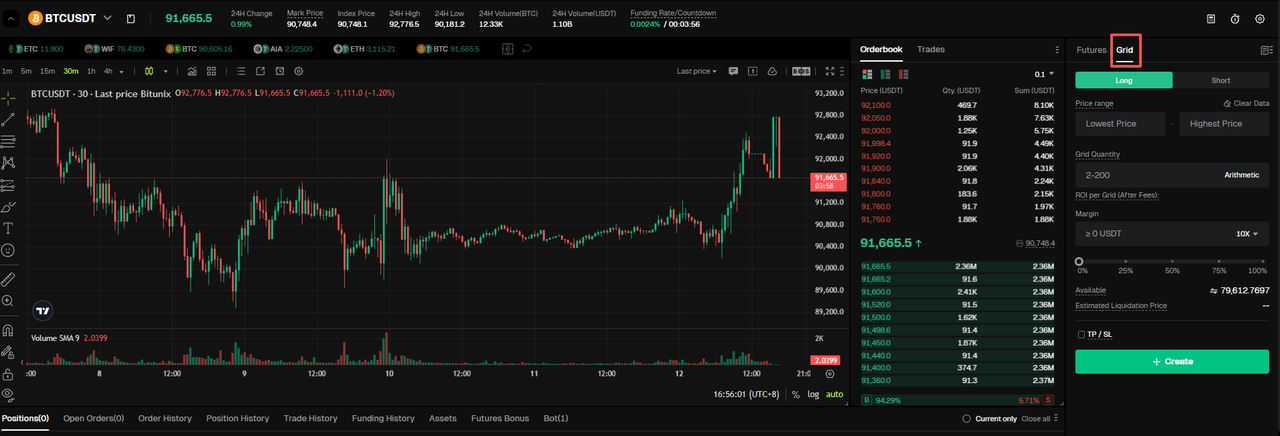
Log in to the Bitunix website and click [Futures Trading] in the top navigation bar. In the trading panel, switch to the [Grid] tab (next to [Futures]).
2、Create a Bot (Set Parameters in the Order Panel)
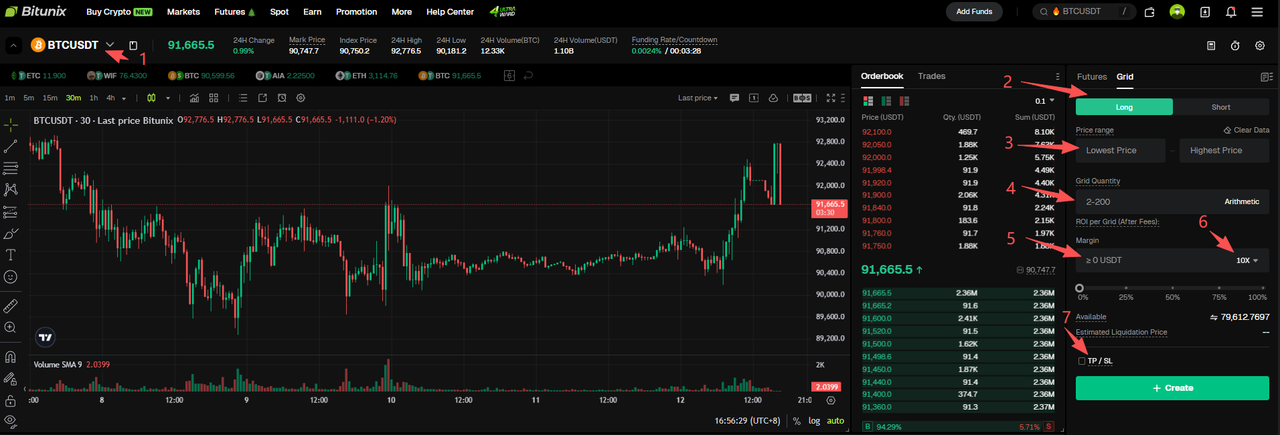
- Select trading pair: Click the symbol (for example, BTC/USDT) and choose the perpetual futures pair you want to trade.
- Choose Long/Short: Select [Long] or [Short] based on your directional preference.
- Set the price range: Enter the Lower Price and Upper Price for the grid. The bot will place orders only within this range.
- Set the number of grids: Enter the number of grids (2 to 200). More grids generally means more frequent trades and smaller profit per grid, while fewer grids means less frequent trades and larger profit per grid.
- Set leverage: Choose your leverage (for example, 5x) using the slider or by entering a value.
- Set the investment amount (margin): Enter the amount of margin you want to allocate. The system will display the minimum required margin under your current settings. Your entered margin must be at least the minimum.
- Advanced settings (optional): Enable Take Profit and Stop Loss if you want the bot to stop automatically when your selected trigger conditions are met.
3、View and Manage a Running Bot
After the bot is created, go to the [Robot] section in the contract trading area to view and manage your Futures Grid.
- Click 【Details】 to open the bot overview page.

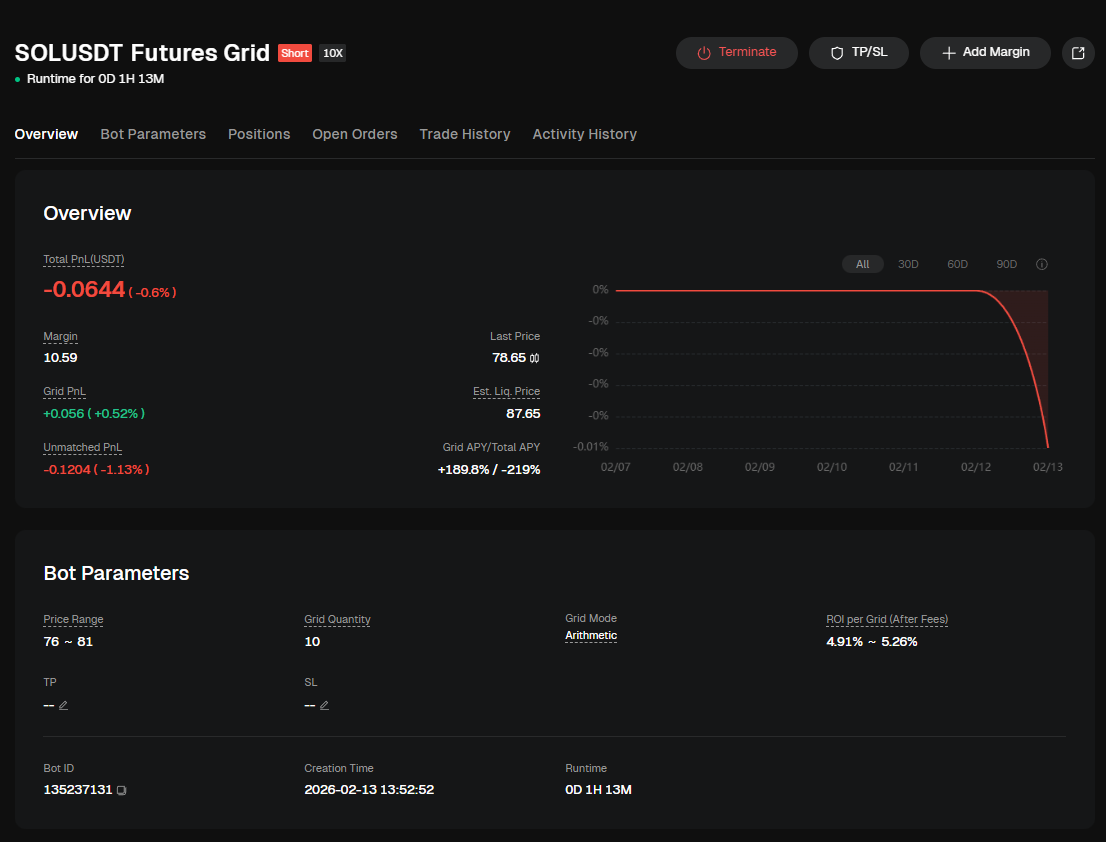
- More options: Use the menu (three-dot icon) to manage settings such as Take Profit, Stop Loss, or Add Margin.
- Share: Use the Share button to share the bot’s performance summary.

4、 Stop the Strategy
You can stop a Futures Grid in either of the following ways:
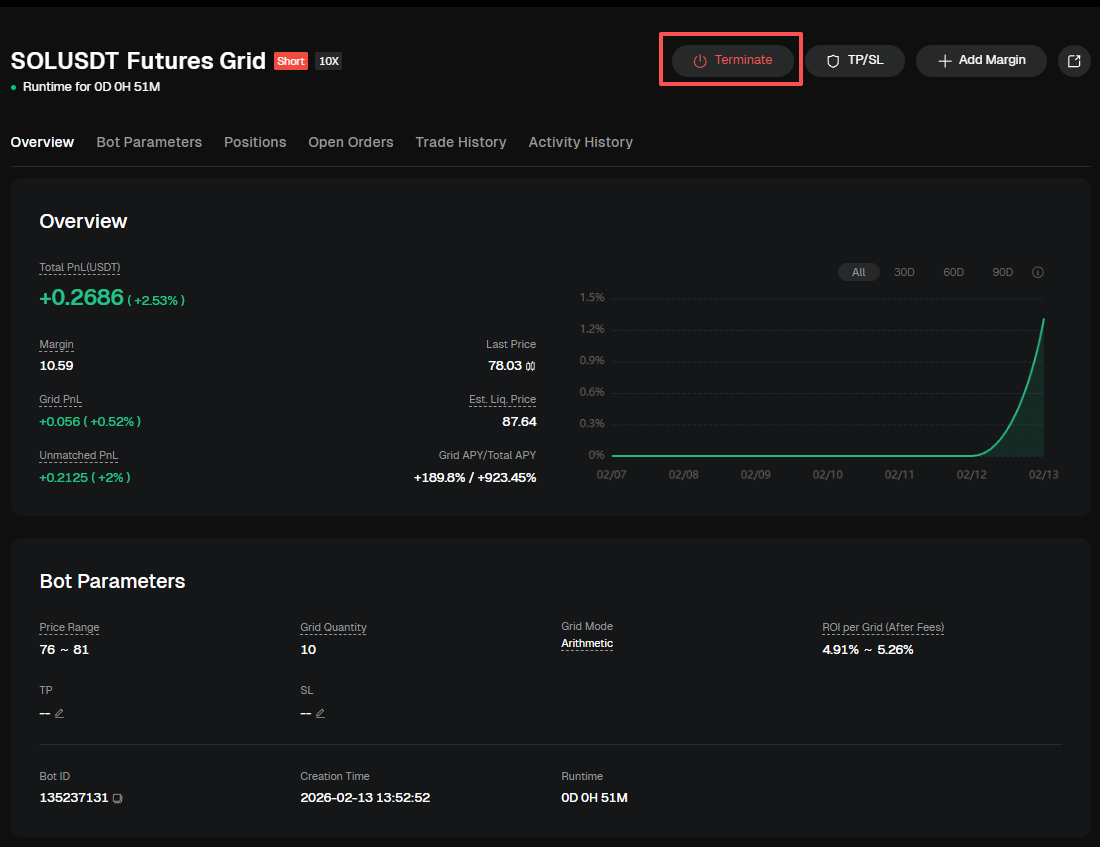
Path 1: Go to the list on the bottom【Bot】tab, locate your target bot (e.g., BTCUSDT Futures Grid 10X), and click the red 【Terminate】icon in the right-side action bar.
Path 2: Go to the【Bot】 list, locate the target bot (e.g., BTCUSDT Futures Grid 10X), enter its details page, and click the red 【Terminate】 icon at the top-right corner.
After you confirm, the system will close the bot and handle position settlement automatically. The bot will cancel any open orders and close any remaining position based on the platform’s execution logic. After the strategy stops, any remaining funds (including realized PnL, after fees if applicable) will be transferred back to your Spot Account.

Frequently Asked Questions (FAQ)
(1) Why does enabling futures grid trading require funds from the Spot Account?
A: This is to maximize the security of your funds and the stability of strategy execution.
Funds in the Futures Account are mainly used as margin to support existing futures positions. If the grid bot were to use Futures Account funds directly, during periods of extreme market volatility, the bot’s capital could be affected by the profit and loss of existing futures positions. This may result in forced strategy termination and even trigger liquidation risks.
Bitunix adopts a risk isolation mechanism: a dedicated, independent fund is transferred from the Spot Account specifically for running the grid bot. This acts as a separate "security isolation compartment" for your strategy. Regardless of fluctuations in market conditions or positions in your Futures Account, the normal operation of the grid strategy will not be impacted. The two operate independently, providing enhanced safety and stability.
(2) Why can’t I create a bot?
If you cannot create a Futures Grid bot, check the following:
- Available balance: Make sure you have enough available funds to meet the minimum margin requirement.
- Bot limit: Confirm you have not reached the maximum number of active grid bots allowed for your account.
- Parameter settings: Review your inputs, such as price range and number of grids, and make sure they meet the system requirements. If any requirement is not met, the bot cannot be created.
(3) Where did the money go after creation?
After the bot is created, the margin you allocate is reserved for that bot so it can operate independently. You can review the bot’s allocated funds and performance at any time on the bot details page.
(4) Why is the bot “Paused”?
A bot may show Paused for common reasons such as:
- The market price moved outside the price range you set.
- The trading pair is temporarily unavailable due to system maintenance.
- The bot only trades within your selected range. If price moves outside the range, the bot pauses to avoid trading at unintended levels and can resume when price returns to the range.
(5) Why is Total PnL negative, but Grid PnL is positive?
This can happen. Grid PnL reflects profits generated from completed grid buy and sell cycles. Total PnL includes unrealized PnL from any open position, which can fluctuate with the market. If the market moves against your position direction (for example, price drops while running a long grid), unrealized losses can temporarily outweigh realized grid profits, resulting in negative Total PnL.
(5) What happens when I manually stop the bot?
When you stop a bot manually, the system will cancel any open orders and close any remaining position based on platform execution rules. The final execution price may differ slightly from the displayed price due to normal market factors such as liquidity and slippage.
Disclaimer
This article is not intended to provide
(I) investment advice or investment recommendations;
(Ii) an offer or solicitation to buy, sell or hold digital assets;
(Iii) Financial, accounting, legal or tax advice. Digital assets held (including stablecoins and NFTs) involve high risk and may fluctuate significantly. You should carefully consider whether trading or holding digital assets is right for you based on your financial situation. Please consult your legal/tax/investment professional for your specific situation. Please be responsible for understanding and complying with all applicable local laws and regulations.